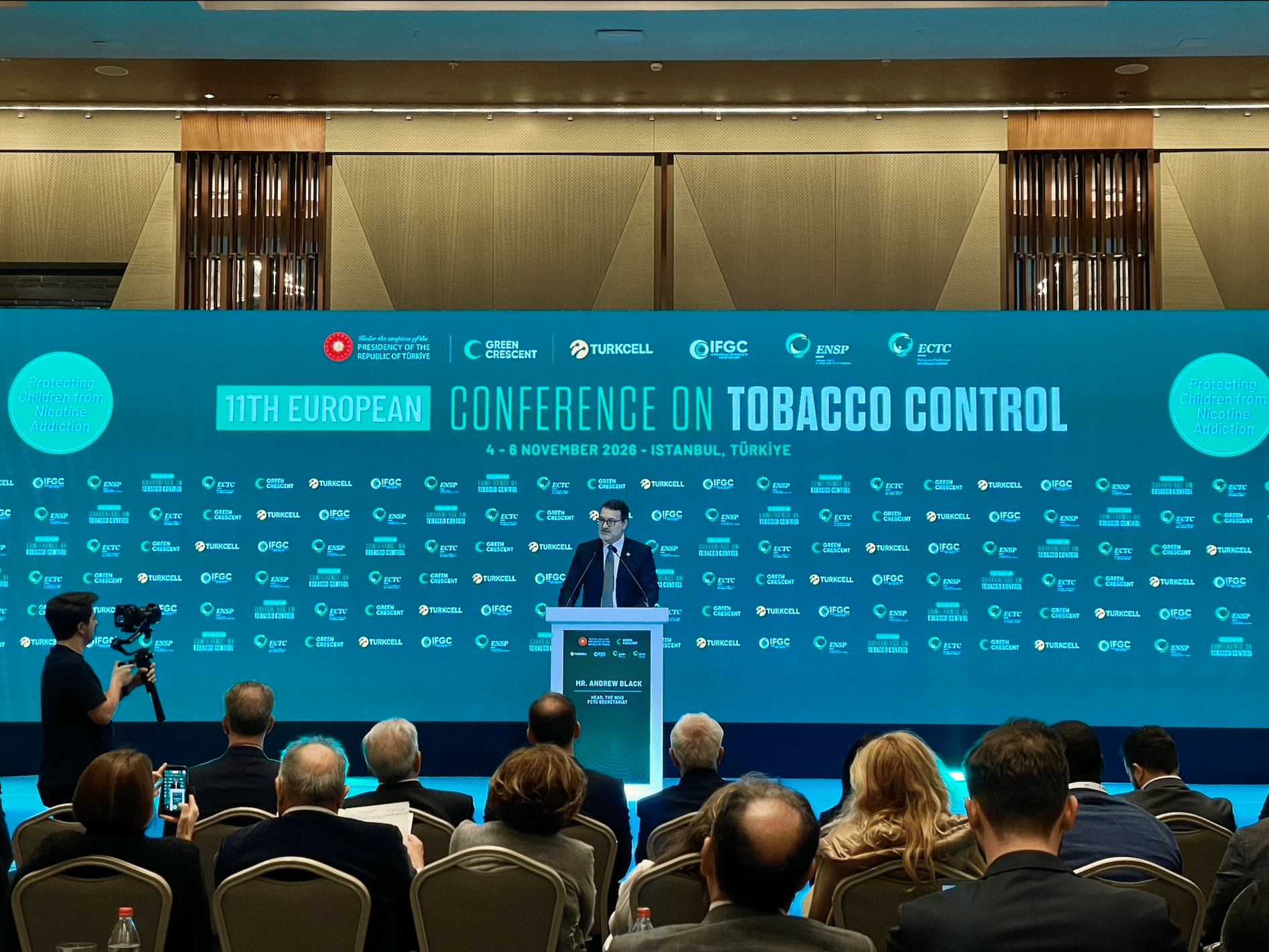
First Lady of the Republic of Palau who is kindly joining the conference,
President of the European Network for Smoking and Tobacco Prevention,
General President of the Turkish Green Crescent Society,
Fellow panellists,
Distinguished guests,
Ladies and gentlemen,
Thank you for the kind invitation to join you for the opening of the 11th European Conference on Tobacco Control.
It is a privilege to be among such a distinguished gathering of leaders, experts, advocates and young people, united by a common purpose: to end the global tobacco epidemic and protect future generations from addiction.
The theme of this conference – protecting young people from nicotine addiction – could not be more timely. Nor could it be more important.
We know that children and young people are particularly vulnerable to nicotine addiction – not only because of how powerfully addictive nicotine is for developing brains but also because of the cynical actions of the tobacco and nicotine industries to recruit young people into using their uniquely harmful products.
We must be concerned about nicotine addiction among children, and about the likely consequences from tobacco and nicotine use into their adult lives.
Young people become addicted to nicotine before they are able to make informed, adult decisions.
We cannot accept that.
As Head of the Secretariat of the WHO Framework Convention on Tobacco Control (WHO FCTC), I want to thank everyone with us today for your work towards a better world through strong tobacco control.
And I particularly thank the European Network for Smoking and Tobacco Prevention (ENSP) for placing young people at the heart of this year’s conference. This is an issue that demands not only our attention but our action.
Ladies and gentlemen,
The human toll of tobacco is staggering.
More than 7 million lives are lost around the world every year because of tobacco use and exposure to second-hand tobacco smoke.
But statistics alone cannot convey the magnitude of that loss.
Behind every number is a person.
Behind every person is a family.
And behind every family is a community that bears the consequences.
Lives are cut short. Opportunities are lost. Families are pushed into poverty. Health systems are placed under enormous strain.
The economic consequences are also profound. The global economic cost of smoking is estimated at 1.8% of the world’s gross domestic product each year.
There has, of course, been progress.
Governments around the world are implementing the evidence-based measures contained in the WHO FCTC. Public understanding of the harms caused by tobacco has grown. Social norms are changing.
Globally, tobacco use prevalence and the overall number of tobacco users is in decline.
These achievements matter.
They demonstrate that the evidence-based measures of the WHO FCTC work.
But progress is not victory.
And nowhere should that warning be taken more seriously than here in Europe.
Tobacco remains a persistent barrier to public health in the WHO European Region.
Europe now has the highest prevalence of tobacco use of any WHO region: more than 24% of adults used tobacco in 2024. It also has the highest prevalence of tobacco use among women.
That should concern everyone at this conference.
And it should compel us to act.
We are seeing governments consider and adopt bold, forward-looking policies capable of accelerating progress. Among them are ambitious smoke-free generation, or end-game, measures, including those adopted in the Maldives and the United Kingdom of Great Britain and Northern Ireland.
For a time, it appeared that we might finally have begun to turn the corner. That we might be winning the war on tobacco use.
Indeed, I have heard senior government officials suggest that the tobacco problem has largely been solved, and that public health attention can now move elsewhere.
Let me be clear: this is no time to look away.
Not while millions continue to die.
Not while tobacco continues to burden health systems and impoverish families.
Not while tobacco use causes so much economic loss and environmental destruction.
And, above all, not while the tobacco industry itself shows no sign of complacency.
The industry continues to evolve. It adapts. It innovates. It invests vast resources in protecting its profits and expanding its markets.
And one objective has remained remarkably constant: recruiting the next generation of nicotine consumers.
For decades, tobacco companies have pursued young people. Internal tobacco industry documents disclosed through litigation reveal a deeply disturbing fixation on attracting young people and sustaining their nicotine addiction over many decades.
Today, the products may look different, but the industry’s strategy remains the same.
Alongside conventional tobacco products, the tobacco and nicotine industry has introduced an expanding range of new products designed to initiate and sustain nicotine addiction.
E-cigarettes are highly addictive and harmful to health. Today, at least 15 million children aged 13 to 15 years are using e-cigarettes.
The global e-cigarette market continues to expand rapidly. Products come in an extraordinary array of designs and flavours. They are aggressively promoted in ways that appeal to younger audiences. And in many countries, use of e-cigarettes among adolescents now exceeds use among adults.
To make things more complex, nicotine pouches and other new nicotine products are also gaining popularity.
What should concern us most is not simply the proliferation of tobacco and nicotine products. It is the way they are designed, packaged and promoted to appeal to young people.
Attractive flavours. Sophisticated product design. Digital promotion. Influencer-led marketing. Products engineered to make nicotine seem modern, fashionable and harmless.
The result is a new generation dependent on nicotine, including young people who might never otherwise have considered using conventional tobacco products.
And governments are too often being forced to play catch-up as products, marketing methods and industry lobbying evolve at an extraordinary pace.
Ladies and gentlemen,
Our responsibility is clear.
We must protect children and young people from addiction.
When it comes to e-cigarettes and other nicotine products, governments must adopt strong regulatory measures within a comprehensive tobacco control strategy, or consider prohibiting their sale altogether.
At the same time, we must remain vigilant to efforts by the tobacco industry to advance their own interests by seeking to shape and control the so-called harm reduction agenda.
On this point, let me be unequivocal.
Governments that have joined the WHO FCTC have a legal obligation to protect public health policies from the commercial and other vested interests of the tobacco industry. This applies to the whole of government – not just the ministry of health.
Tobacco companies continue to seek a seat at the policy-making table.
They must not be allowed to occupy it.
The reason is simple.
The industry is the cause of the tobacco epidemic. It cannot also be its solution.
The transnational corporations that control the global tobacco market are not loyal to any particular government, regardless of where the companies might be headquartered.
Their only loyalty is to shareholders, with the singular aim of maximizing profit.
The tobacco and nicotine industry makes enormous profit while the costs are borne by everyone else: by users of the industry’s products, by families and communities, by health systems, by governments, and let’s not forget, by the environment.
Increasingly, the industry’s profits are being generated in low- and middle-income countries, where the majority of the world’s tobacco users now live.
Ladies and gentlemen,
Allow me to turn briefly to illicit trade.
Illicit trade in tobacco products represents a serious criminal and public health challenge in many countries.
But we must also recognize that claims about illicit trade have been repeatedly used by the tobacco industry to resist or weaken effective tobacco control measures.
For years, tobacco companies have argued that stronger tobacco control policies will inevitably fuel illicit markets.
But the decisive answer to illicit trade is not weaker public health policy.
It is stronger enforcement.
This is precisely why governments should become Parties to, and fully implement, the Protocol to Eliminate Illicit Trade in Tobacco Products.
So, where do we go from here?
In fact, the path before us is remarkably clear.
We know what works to protect children from tobacco and nicotine. The WHO FCTC gives us the direction we need.
We just need the determination to implement the Convention fully.
We need tax and price measures that make tobacco and nicotine products less affordable, particularly for young people.
We need comprehensive bans on advertising, promotion and sponsorship of tobacco and nicotine products.
We need prominent graphic health warnings, and we need governments to consider plain packaging.
We need effective enforcement of minimum-age restrictions. Children must not be allowed to buy or sell nicotine.
We need to continue to work towards changing social norms around tobacco and nicotine use. This starts by encouraging and supporting adults to quit. Parents and older siblings are influential role models for young people.
And we must especially confront tobacco and nicotine promotion in cross-border entertainment media, including social media, in line with the guidelines agreed at the Tenth session of the Conference of the Parties to the WHO FCTC.
But policy alone is not enough.
We also need the voices, energy and leadership of young people themselves.
Young people should not simply be the subjects of tobacco control policy.
They should have a meaningful role in shaping it.
I therefore want to acknowledge and thank the youth representatives who have joined this conference.
Your voices matter.
Your ideas matter.
And your determination will help shape the future we are working to build.
Ladies and gentlemen,
The WHO FCTC is a landmark achievement in global public health. It brings countries together around a common purpose: to protect present and future generations from the devastating health, social, environmental and economic consequences of tobacco.
Today, I ask all of you to renew your commitment to its full implementation.
I ask you to continue advocating for stronger tobacco control in your countries and communities.
I ask governments that have not yet done so to join and implement the Protocol to Eliminate Illicit Trade in Tobacco Products.
And I ask all of us to remember what is at stake.
A child should be free to grow, learn, make choices and fulfil their potential without being targeted for addiction in the interests of commercial profit.
That is the future we must work towards.
Let me conclude by thanking ENSP for its leadership and hard work to strengthen tobacco control in Europe.
Thank you to all our friends in Türkiye for hosting this important conference.
We must be as persistent in advancing public health as the tobacco industry is in protecting its profits.
Let us accelerate implementation of the WHO FCTC.
Let us stand firmly against the commercial exploitation of children.
And above all, let us ensure that the next generations inherit the freedom to live healthier lives, free from addiction.
I wish you all the very best for your important work and good luck for the conference this week.
Thank you.


First Lady of the Republic of Palau who is kindly joining the conference, President of the European Network for Smoking and Tobacco Prevention, General President of the Turkish Green...
Your Excellencies, Distinguished Religious Leaders, Distinguished Representatives of International Organisations, Dear Colleagues, Ladies and Gentlemen, On behalf of ENSP, thank you for honouring us with your presence at the...

Kick-off meeting: Yerevan, Armenia Date: 13 October 2026 A new European Union-funded research project, ACTS – Accelerating Tobacco Cessation within Healthcare Systems of European LMICs, marks its official launch today...
