A Europe that fails to protect its children from nicotine addiction is undermining not only their health and potential, but also its own future competitiveness.
Across Europe and around the world, a new generation of children is growing up in an environment where nicotine products are increasingly visible, accessible and designed to attract attention. Flavours, appealing designs, sophisticated marketing and the rapid emergence of new products are changing the landscape of nicotine use. For many young people, experimentation can become dependence before they fully understand the risks.
This is not simply a question of individual choice. It is a public-health challenge — and, above all, a question of our responsibility to protect children.
The developing brain is particularly vulnerable to nicotine. Exposure during childhood and adolescence can lead to dependence and may affect brain development, learning, attention and emotional regulation. Preventing nicotine addiction must therefore begin before dependence takes hold. It requires more than information and awareness: it requires effective protection, consistent prevention policies and a commitment to putting the health of children first.
ENSP’s origins are closely connected to the development of European cooperation in tobacco prevention and control. In 1996, the European Commission supported the development of a European umbrella organisation to bring together national organisations working in tobacco prevention and control. This process led to the establishment, in 1997, of the European Network for Smoking and Tobacco Prevention — ENSP.
The European Commission’s memorandum of June 1996 outlined a strategy for cooperation with the new European network. It envisaged coordinated annual action programmes, bringing together the work of organisations across Member States and submitting a comprehensive annual project to the Commission for financial support.
ENSP was therefore not created by chance. It emerged from a European vision: that tobacco prevention required coordination, shared expertise, strong national organisations and sustained cooperation at European level.
That founding vision remains relevant today. The challenges have evolved, new nicotine products have emerged and the need for coordinated action has become even greater. But the underlying purpose has not changed: to protect public health through cooperation, prevention, shared knowledge and evidence-based policies.
ENSP is an international non-profit public-health organisation. Its purpose is not to sell products, promote commercial solutions or represent the interests of a particular market. Its work is guided by the prevention of disease, the protection of health and the promotion of evidence-based tobacco-control policies.
As a network bringing together organisations and professionals committed to public health, ENSP has a responsibility to speak clearly about the risks of nicotine addiction, to support effective prevention and to ensure that the voices of public-health experts, researchers, healthcare professionals, educators, families and civil society are heard.
This responsibility is especially important when the health and future of children are at stake.
Europe has an opportunity — and a responsibility — to provide a coherent response to the changing nicotine landscape. Public-health policies must keep pace with new products, new marketing techniques and new patterns of use. Measures designed for an earlier generation of tobacco products cannot automatically address the challenges posed by today’s wider range of nicotine products.
A comprehensive European approach should place the protection of children at its centre. It should prevent products and marketing practices from appealing to minors, strengthen prevention and education, support families and schools, and ensure that regulation is informed by independent scientific evidence.
It should also recognise that public-health policy must be protected from commercial interests that may conflict with the objective of preventing addiction and disease. Transparency, scientific independence and accountability are essential to maintaining public trust and ensuring that health considerations remain paramount.
The Istanbul Declaration reminds us that the next generation should not have to grow up navigating an environment in which addictive products are made attractive, normalised or readily accessible.
Children have the right to grow, learn and develop without being targeted by practices that expose them to nicotine dependence. Parents and educators have the right to clear, reliable information. Policymakers have a responsibility to act on the available evidence and to ensure that public-health objectives guide their decisions.
The task ahead requires cooperation across countries, institutions and communities. It requires courage to address emerging challenges, consistency in applying public-health principles and the determination to turn commitments into measurable progress.
The success of tobacco and nicotine prevention should not be measured only by the policies adopted or the declarations signed. It should be measured by whether fewer children start using nicotine, whether fewer young people become dependent and whether future generations enjoy healthier lives.
The Istanbul Declaration 2026 gives us a shared direction. Now its principles must be translated into action.
ENSP will continue to work with its partners and the wider public-health community to advance this mission, defend scientific independence and promote policies that put the health of present and future generations first.
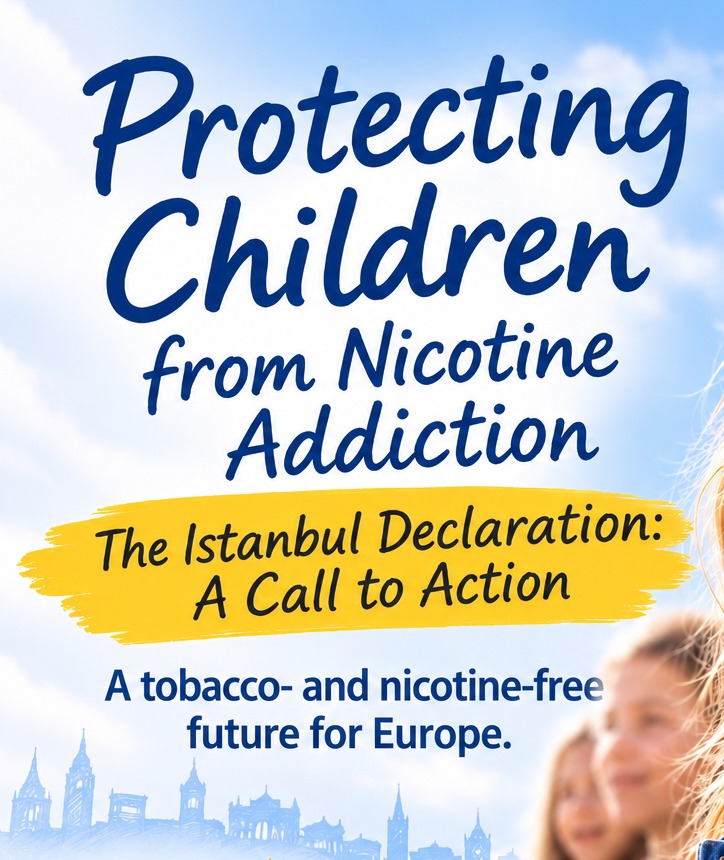
The Istanbul Declaration 2026 – Protecting Children from Nicotine Addiction, was adopted by ENSP and the Turkish Green Crescent Society (Yeşilay) at the conclusion of the 11th European Conference on Tobacco Control, held in Istanbul from 4 to 6 November 2026.
The Declaration calls upon the international community to unite in protecting children from addictive nicotine products. It recognises that the increasing use of nicotine products by minors is an urgent cross-border challenge, that nicotine exposure during childhood and adolescence raises particular concerns for brain development, and that existing legislative and regulatory frameworks have not adequately protected children from the promotion of addictive products.
It sets out four urgent priorities for action:
The Declaration also sends a clear message to policymakers: lengthy legislative revision processes must not delay immediate protective action.
For ENSP, these commitments should guide both European and national policy decisions. The protection of children from nicotine addiction must be placed at the centre of tobacco control strategies, legislative reforms and international cooperation.
ENSP calls for the explicit preservation of the objective of achieving a Tobacco-Free Generation by 2040 and for a prompt and comprehensive revision of EU tobacco control legislation.
The revised legislative framework must explicitly address all tobacco and nicotine products, including electronic cigarettes, heated tobacco products, nicotine pouches and emerging products. It must be based on a technology-neutral approach, ensuring that new products do not escape effective public health regulation.
Socio-economic impact assessments may be relevant to policymaking, but they must never become a justification for delaying measures necessary to protect public health, particularly children’s health.
ENSP opposes proposals that would remove commitments to increase and harmonise minimum tobacco excise duties, weaken plain packaging requirements or dilute restrictions on advertising, promotion and product visibility at points of sale.
Illicit trade must be addressed through effective traceability systems, enforcement and implementation of the WHO Protocol to Eliminate Illicit Trade in Tobacco Products. It must not be used as an argument against effective health taxation.
Public health policies must also ensure that all forms of tobacco and nicotine consumption are adequately addressed, rather than focusing exclusively on conventional smoking.
Protecting children, workers and non-smokers from involuntary exposure to tobacco smoke and aerosols is a fundamental public health responsibility.
ENSP therefore supports strong European measures promoting smoke- and aerosol-free environments. National competences must not be used to weaken common standards or undermine the protection of citizens from involuntary exposure.
In light of the European Parliament’s assessment of Europe’s Beating Cancer Plan and the commitments expressed in the Istanbul Declaration 2026, ENSP calls on Members of the European Parliament and European policymakers to:
The Istanbul Declaration 2026 provides a renewed collective commitment and a clear call for action. ENSP urges European institutions, national governments, public health organisations and civil society to translate this commitment into concrete policies and effective protection.
Protecting children from nicotine addiction is not an option to be postponed. It is a responsibility we share and a responsibility we must fulfil.


A Europe that fails to protect its children from nicotine addiction is undermining not only their health and potential, but also its own future competitiveness. Across Europe and around...

The 11th European Conference on Tobacco Control concluded with a shared commitment and a clear message to the international community. Adopted by ENSP and the Turkish Green Crescent, the...
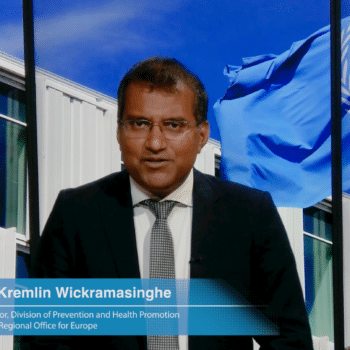
At the 11th European Conference on Tobacco Control in Istanbul, the Director of the Division of Prevention and Health Promotion at WHO Europe, Dr Kremlin Wickramasinghe, delivered a powerful...
