At the 11th European Conference on Tobacco Control in Istanbul, the Director of the Division of Prevention and Health Promotion at WHO Europe, Dr Kremlin Wickramasinghe, delivered a powerful message on the urgency of protecting children from emerging nicotine products and the importance of turning scientific evidence into decisive policy action.
With youth nicotine use on the rise, his remarks remind us that protecting future generations requires sustained political commitment, international cooperation and collective responsibility.
“Excellencies, distinguished guests, dear colleagues and partners,
It is a great pleasure to address you at the 11th European Conference on Tobacco Control. I sincerely regret that I cannot join you in person.
Let me begin by thanking our hosts in Türkiye and the European Network for Smoking and Tobacco Prevention for bringing together policymakers, researchers, health professionals and civil society representatives around a shared public health priority.
The theme of this year’s conference, “Protecting Children from Nicotine Addiction: Science, Policy, Society, Global Action,” could not be more timely.
Over the past decades, we have made significant progress in tobacco control. The WHO Framework Convention on Tobacco Control has provided a strong foundation for policies that have protected globally millions of people from tobacco-related harm.
Yet progress remains uneven, with substantial differences in implementation across countries — from global leaders in tobacco control to countries where essential measures remain insufficiently implemented. Overall, the burden of tobacco use remains unacceptably high. The WHO European Region continues to have the highest prevalence of tobacco use among adults globally, with a particularly high burden among women. Without accelerated action, the Region is projected to retain this position through 2030.
At the same time, we face new and rapidly evolving challenges.
While cigarette smoking has declined in many countries, new tobacco and nicotine products are increasingly reaching children and adolescents.
The latest WHO estimates show that 14.3% of adolescents aged 13–15 in the WHO European Region use electronic cigarettes — the highest prevalence among all WHO regions.
Flavours, attractive packaging, social media promotion and influencer marketing are making nicotine products increasingly appealing and accessible to children.
Children should not grow up in an environment where nicotine addiction is made attractive, accessible and socially acceptable. It is our collective responsibility to change that environment.
This is why the four pillars of this conference — science, policy, society and global action — are so important.
Science must guide our decisions through independent research and robust surveillance. Policy must translate evidence into effective regulation. Society — including health professionals, educators, parents, civil society and young people themselves — must be actively engaged in shaping solutions. And international cooperation is essential to address industry and marketing practices that transcend national borders.
Experience has shown that strong political commitment and comprehensive tobacco control policies can deliver remarkable results, even within a relatively short period.
Yet leadership is not defined only by past achievements, but also by the determination to sustain and build upon them. Emerging products, evolving patterns of tobacco and nicotine use, and challenges in policy implementation and enforcement remind us that progress cannot be taken for granted.
Without sustained action, hard-won gains risk being reversed.
Dear colleagues,
Protecting children from nicotine addiction is not only about preventing the use of harmful products. It is about safeguarding their health, their rights and their opportunity to grow up free from addiction.
We have the evidence. We have proven policy tools. And we have a strong community of committed partners.
What we need now is the political determination to act — decisively, collectively and without delay.
Let us use this conference to strengthen partnerships, share effective approaches and translate knowledge into meaningful action.
The next generation deserves more than our concern. They deserve our protection through the actions we take today.
On behalf of the World Health Organization, I thank ENSP, our hosts in Türkiye – the Turkish Green Crescent — and all partners and participants for your continued commitment.
I wish you a productive and successful conference.
Thank you.”


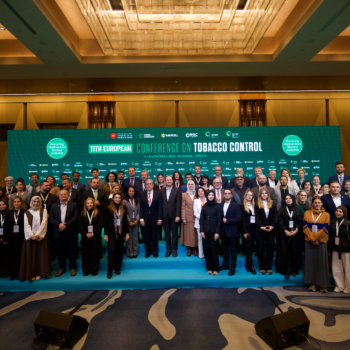
The 11th European Conference on Tobacco Control concluded with a shared commitment and a clear message to the international community. Adopted by ENSP and the Turkish Green Crescent, the...
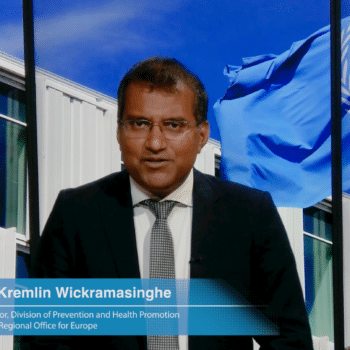
At the 11th European Conference on Tobacco Control in Istanbul, the Director of the Division of Prevention and Health Promotion at WHO Europe, Dr Kremlin Wickramasinghe, delivered a powerful...
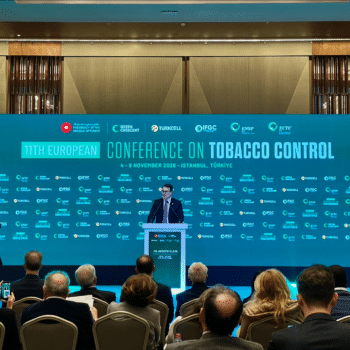
First Lady of the Republic of Palau who is kindly joining the conference, President of the European Network for Smoking and Tobacco Prevention, General President of the Turkish Green...
